Costa Rica Week 7: How We’re Worldschooling
This week our update looks a little different, with a deeper dive into how we are feeling about worldschooling and what the actual “school part” of our trip looks like. That’s because, after last week’s thrills in La Fortuna, we had a “boring” week of mostly “just doing school.” We’ve also included a contact form at the bottom so you can ask questions of any of us – we’ll do our best to answer them in next week’s post!
But before we get too deep into the “how’s” of our worldschooling, here are a couple highlights of the week:
Highlights of the Week
Living in Bijagua de Upala
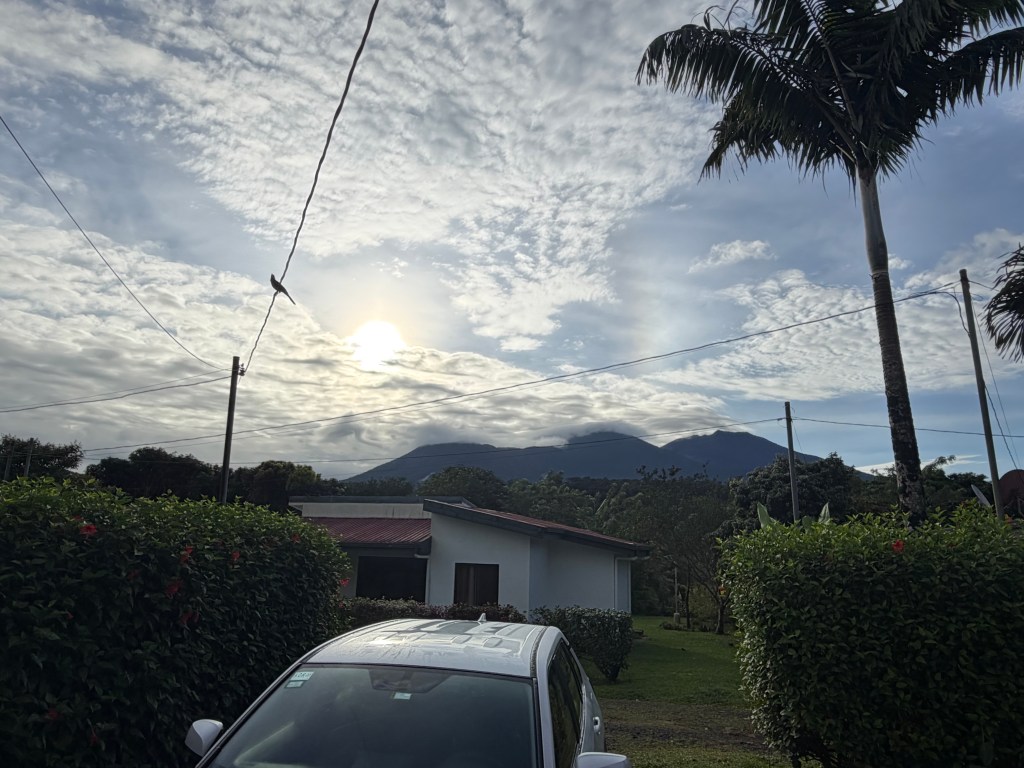
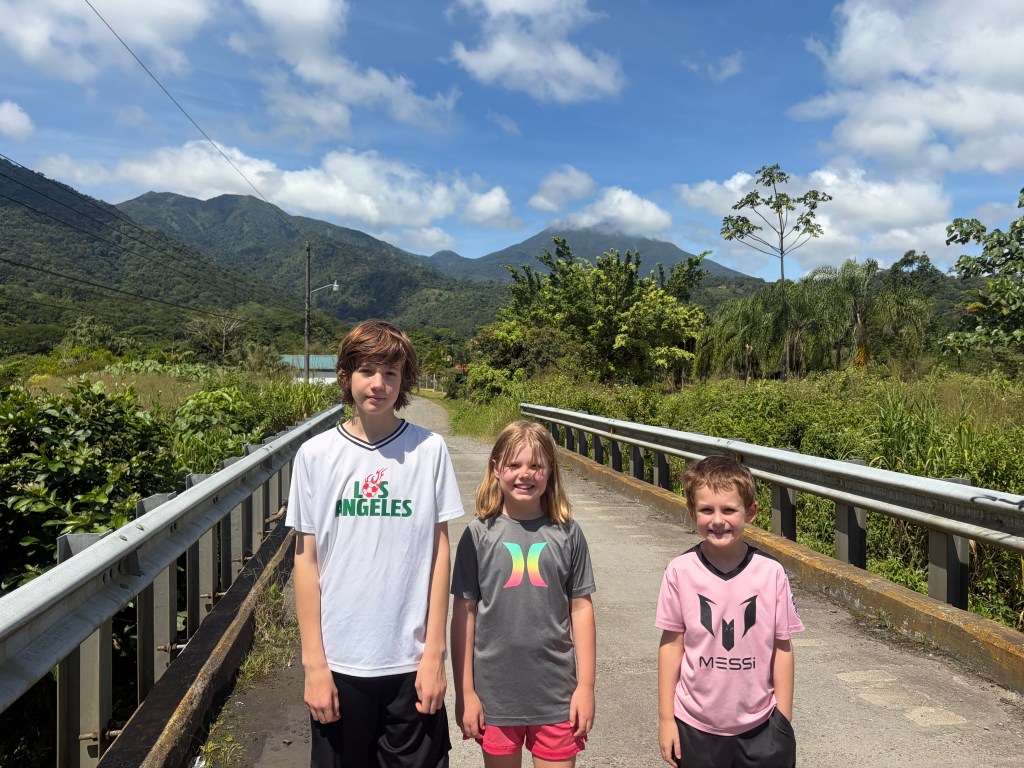
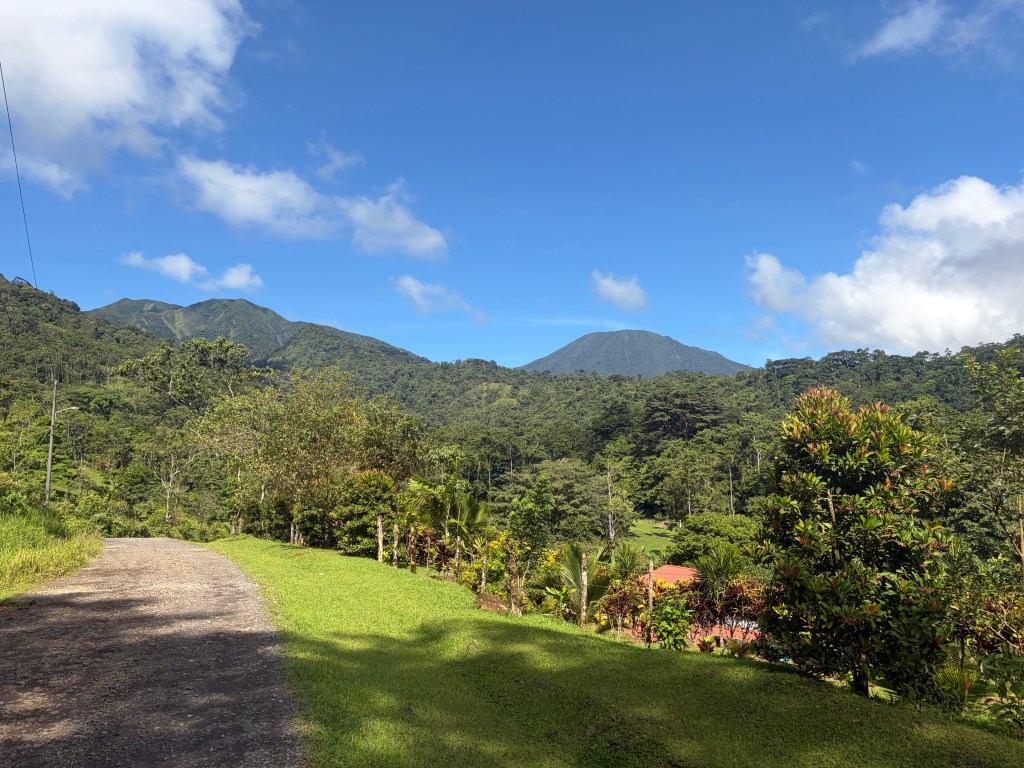
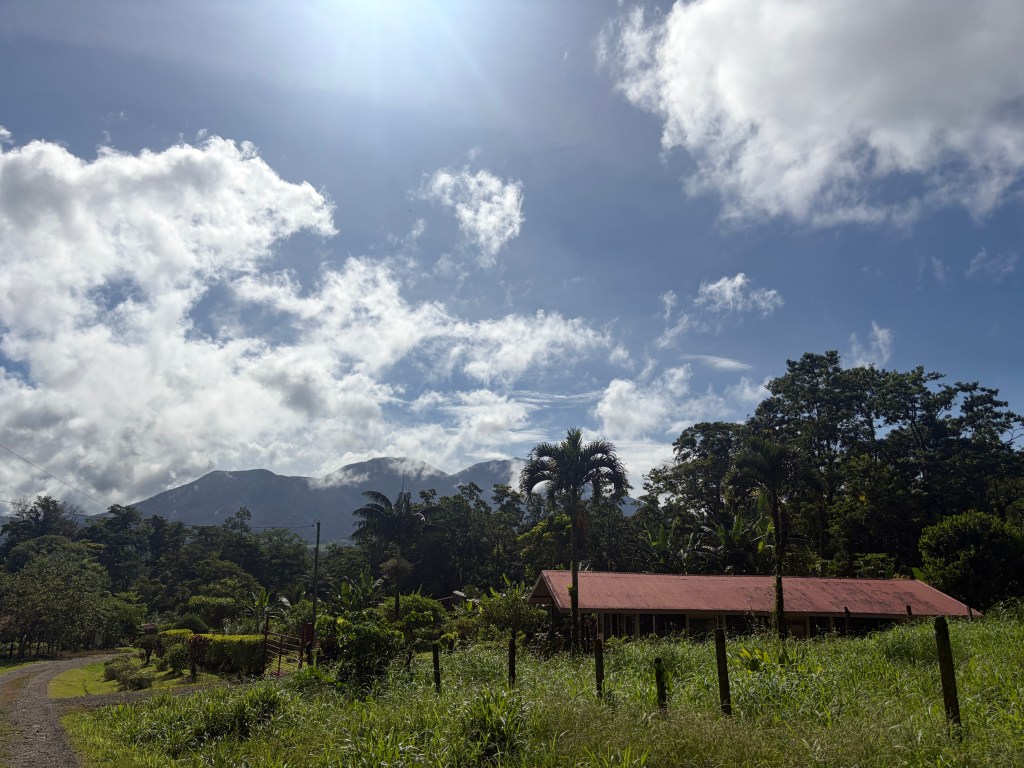
We spent last week living in a cozy Tico neighborhood in the town of Bijagua de Upala. The view of Tenorio Volcano from our front door was stunning and I particularly enjoyed taking half hour walks up and down our side road (though the kids’ opinions on that subject were less enthusiastic). We could see and hear dozens of different birds from our house, including the great-tailed grackle, which often made mocking-like “ha-ha” noises as part of its repertoire (sometimes timed quite serendipitously). And we had lots of visits from tiny neighborhood dogs, and even a curious neighborhood boy.
Visit to Tenorio Volcano National Park and Rio Celeste
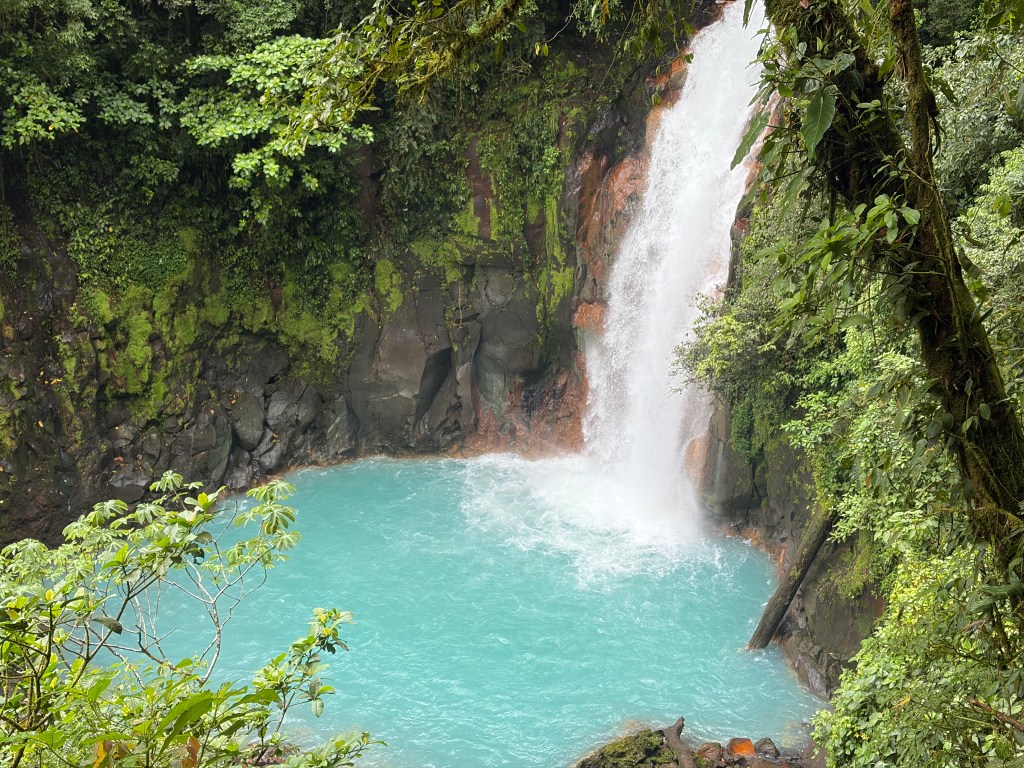
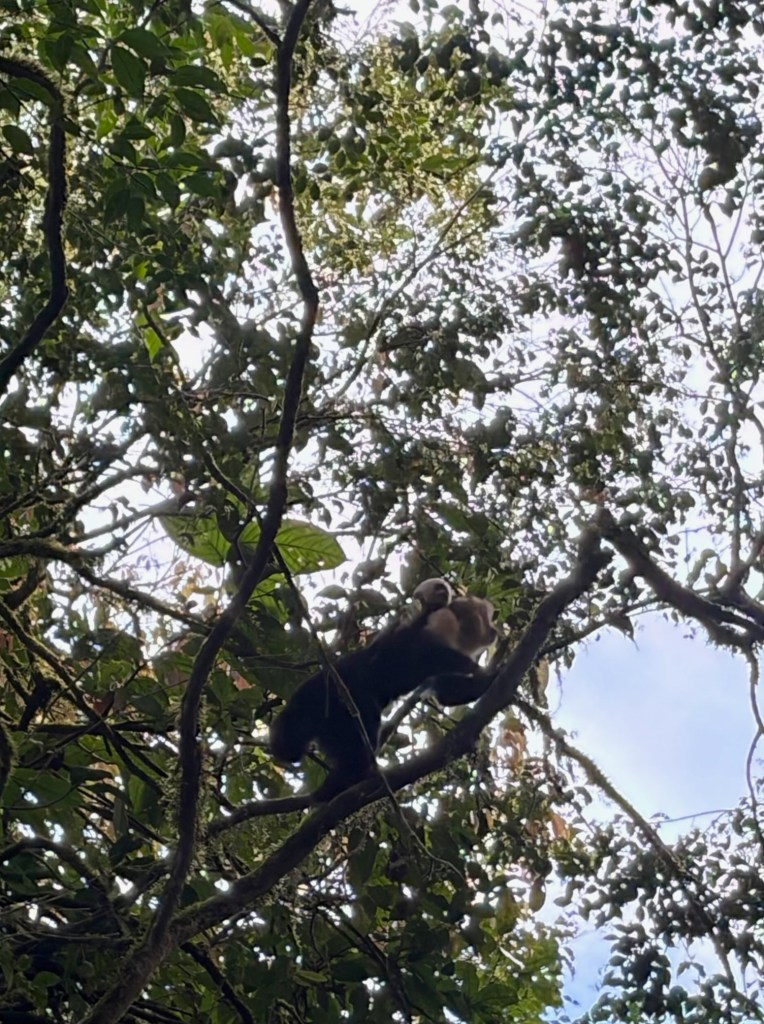
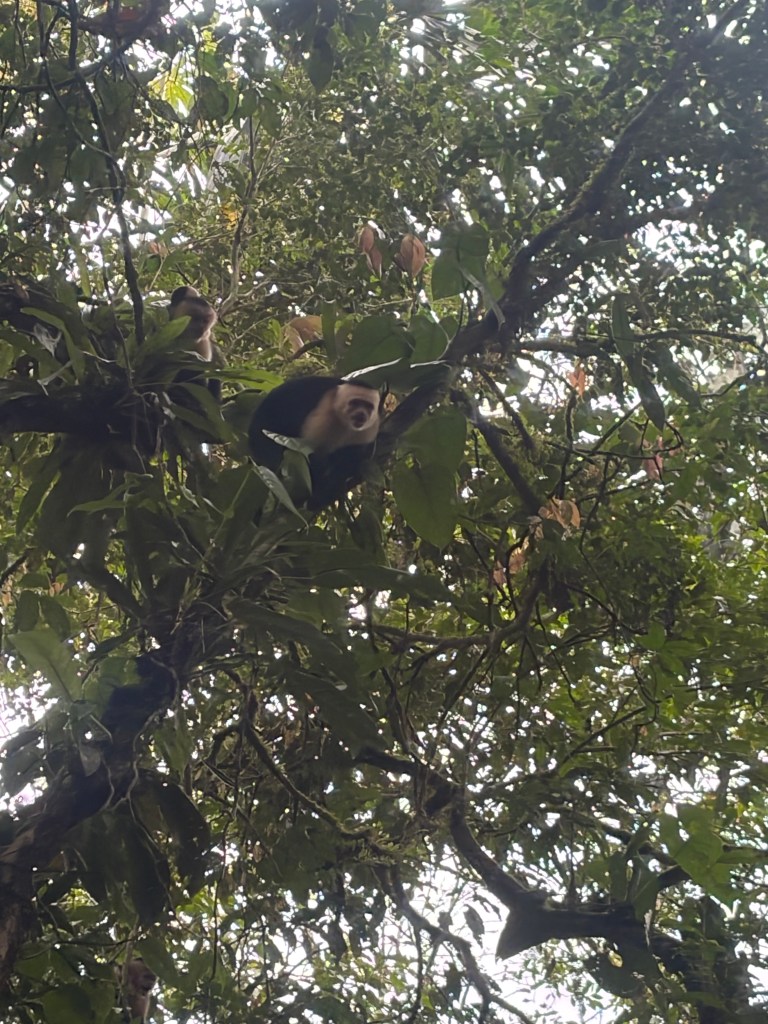
After a week spent staring up at the cones of Tenorio Volcano National Park, we finally made it up the mountain for a Saturday morning hike. The highlight of the national park is the Rio Celeste – a hot spring-fed river that turns a vibrant milky blue before cascading over a stunning waterfall. Local legend says that God washed his paintbrushes in the Rio Celeste after painting the sky, resulting in its famous bright blue color. In fact, the blue color is a result of sunlight hitting microscopic mineral particles that mix at the intersection of two rivers, Quebrada Agria and Rio Buena Vista. Either way, it’s pretty stunning to see. And we got to see a troop of white-faced capuchin monkeys on the trail, too, so that was an extra bonus!
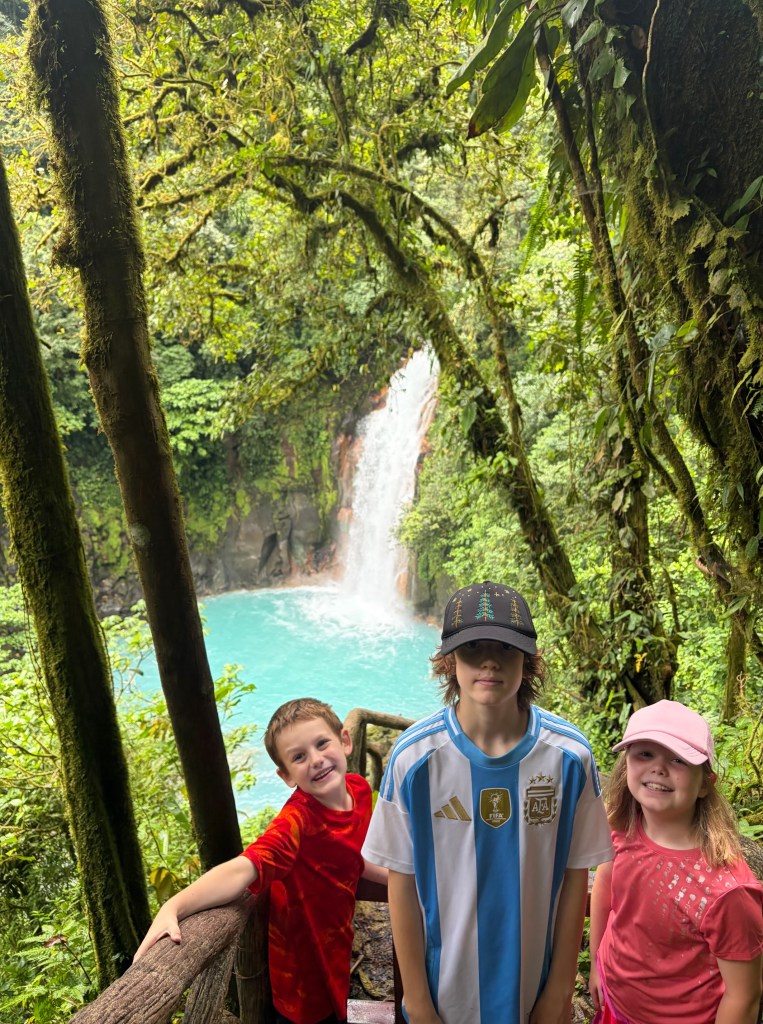
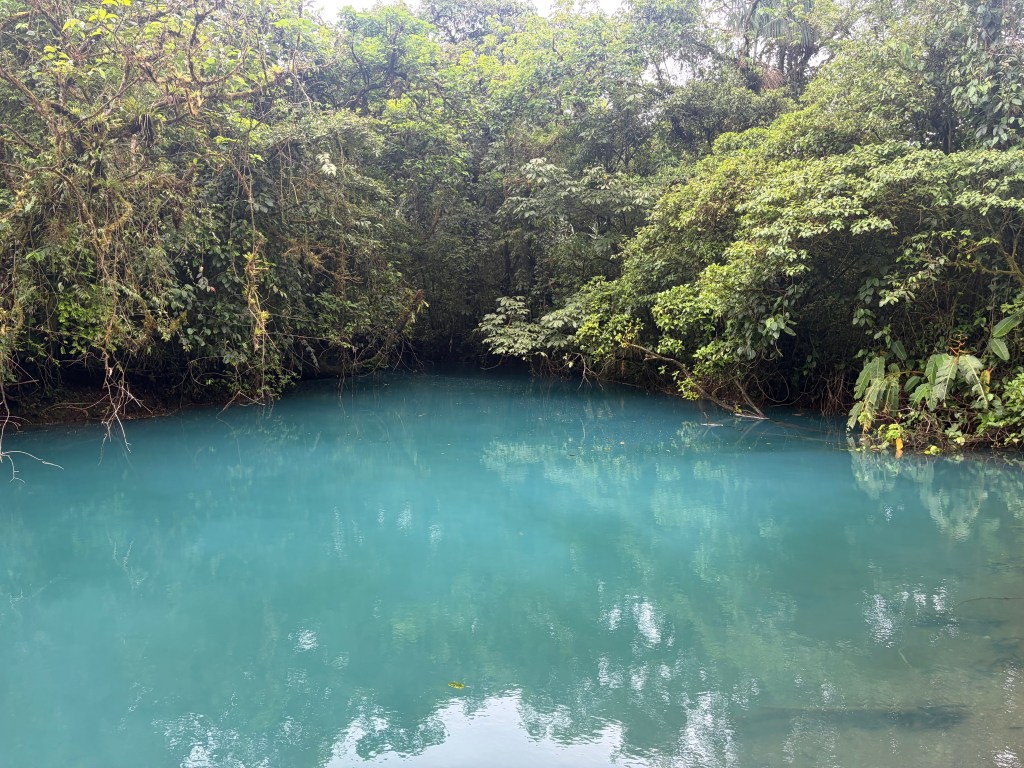
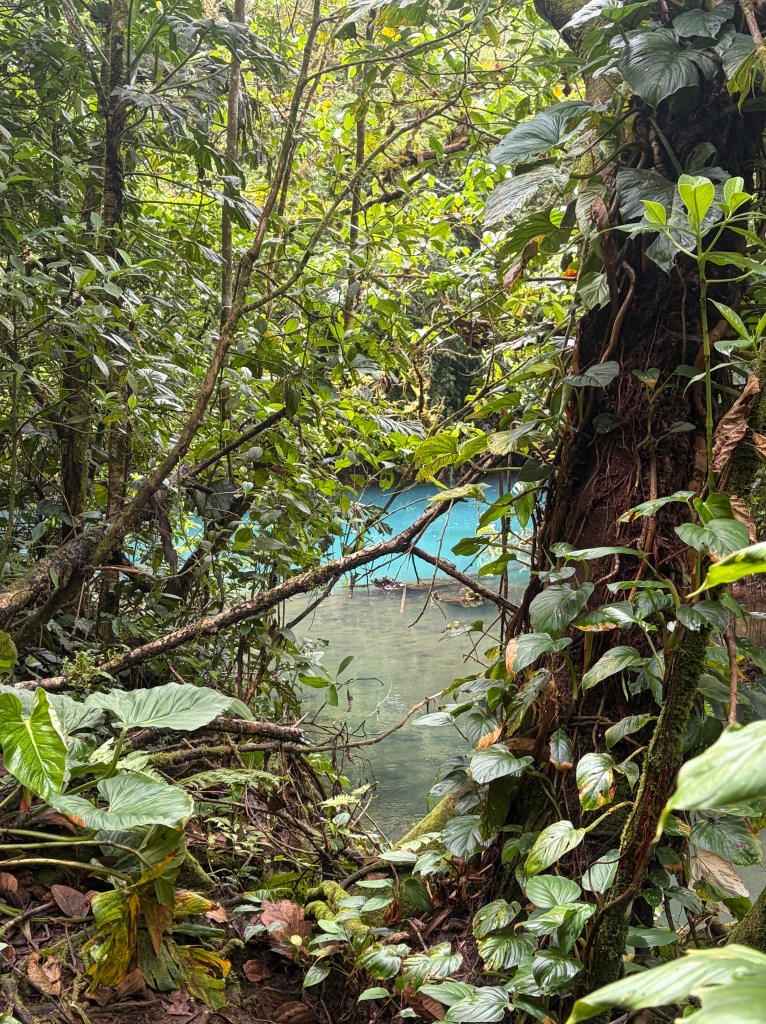
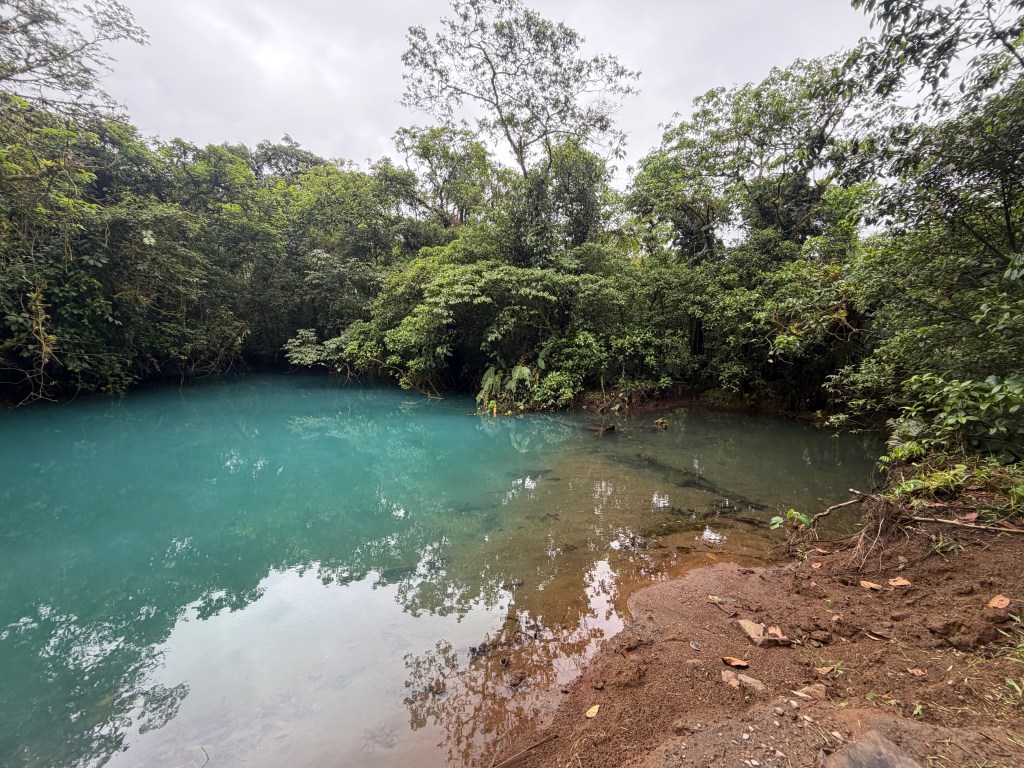
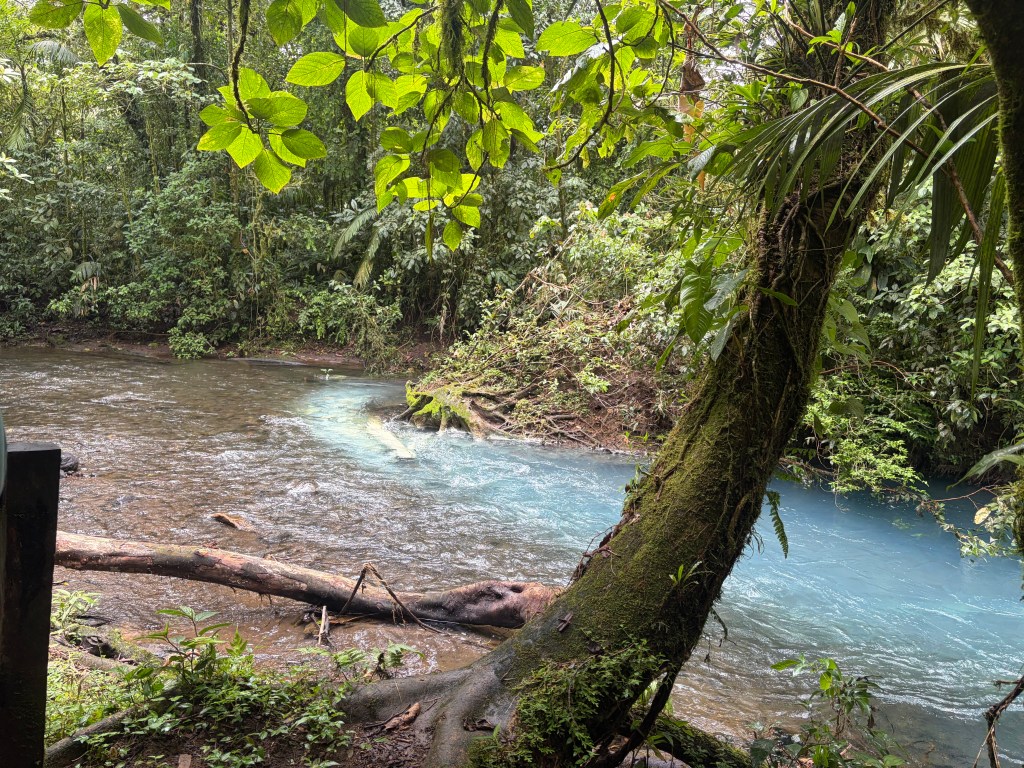
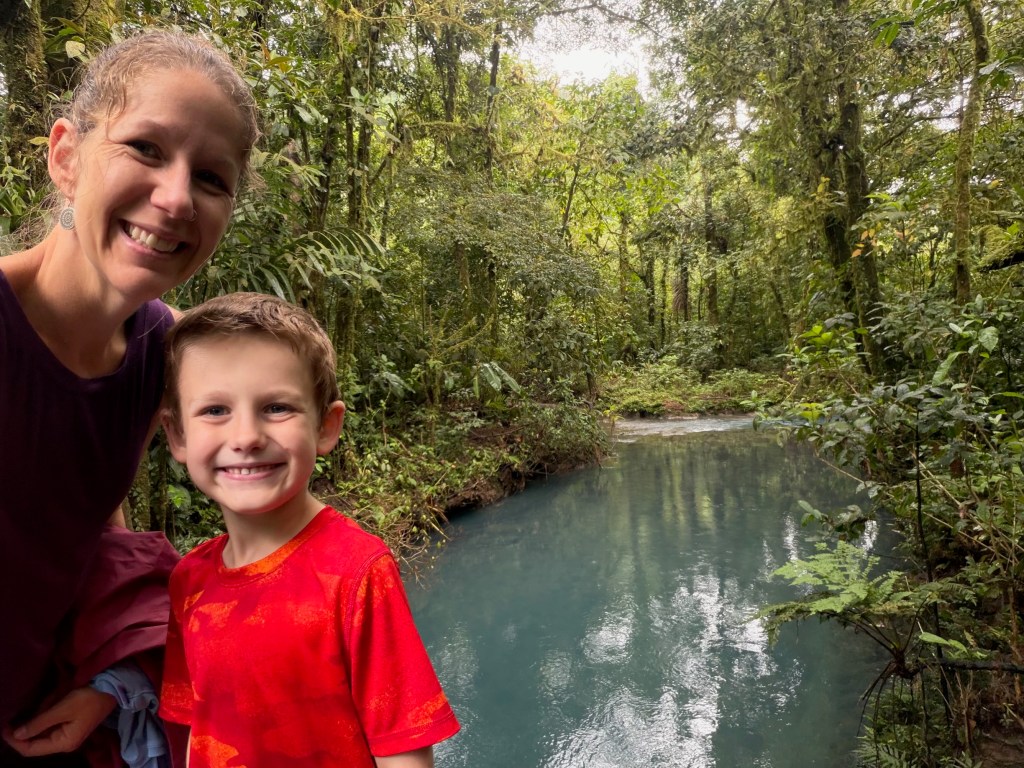
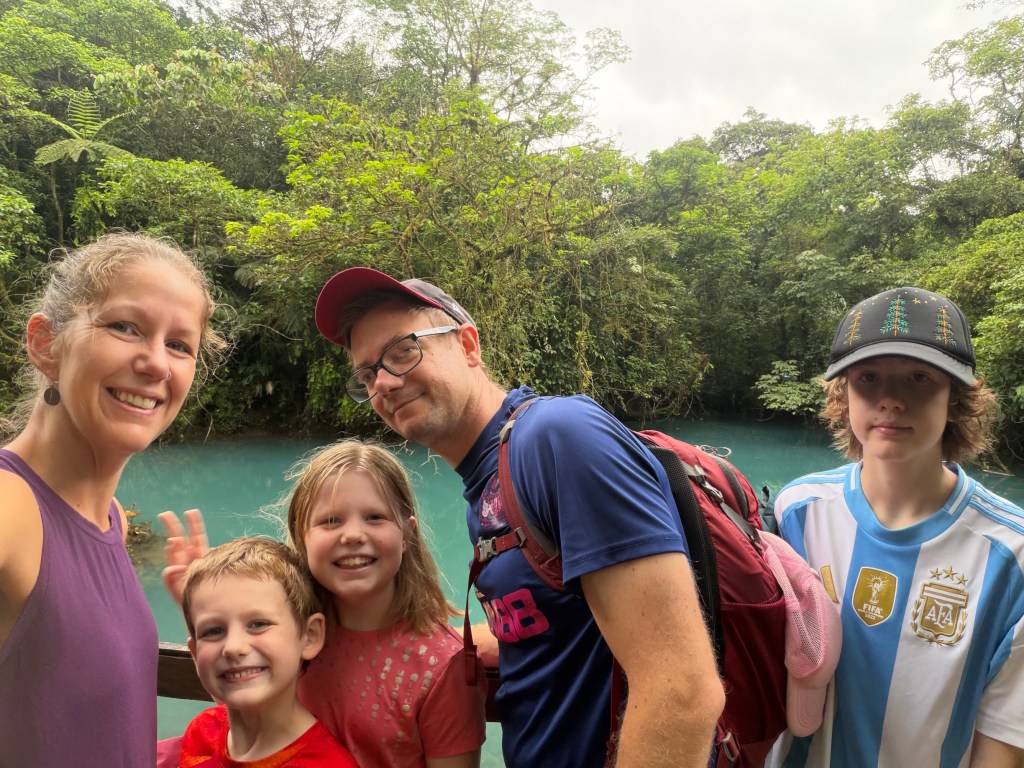
Despite the ever-present heat, humidity, and mud, the kids did a great job on the hike overall!
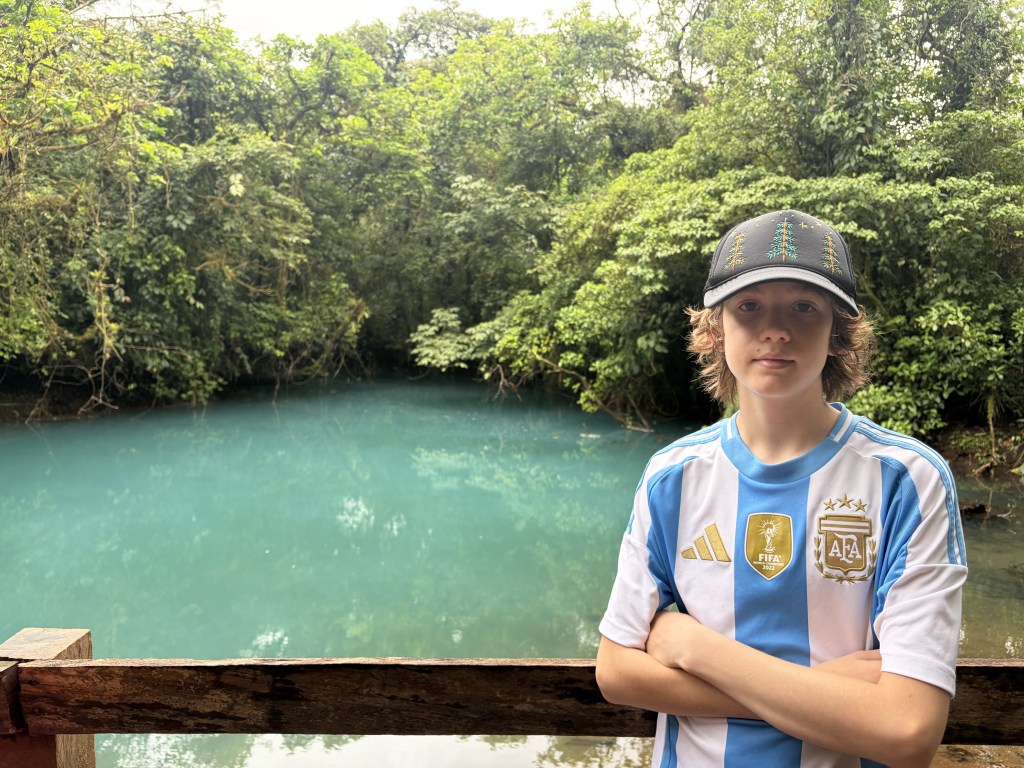
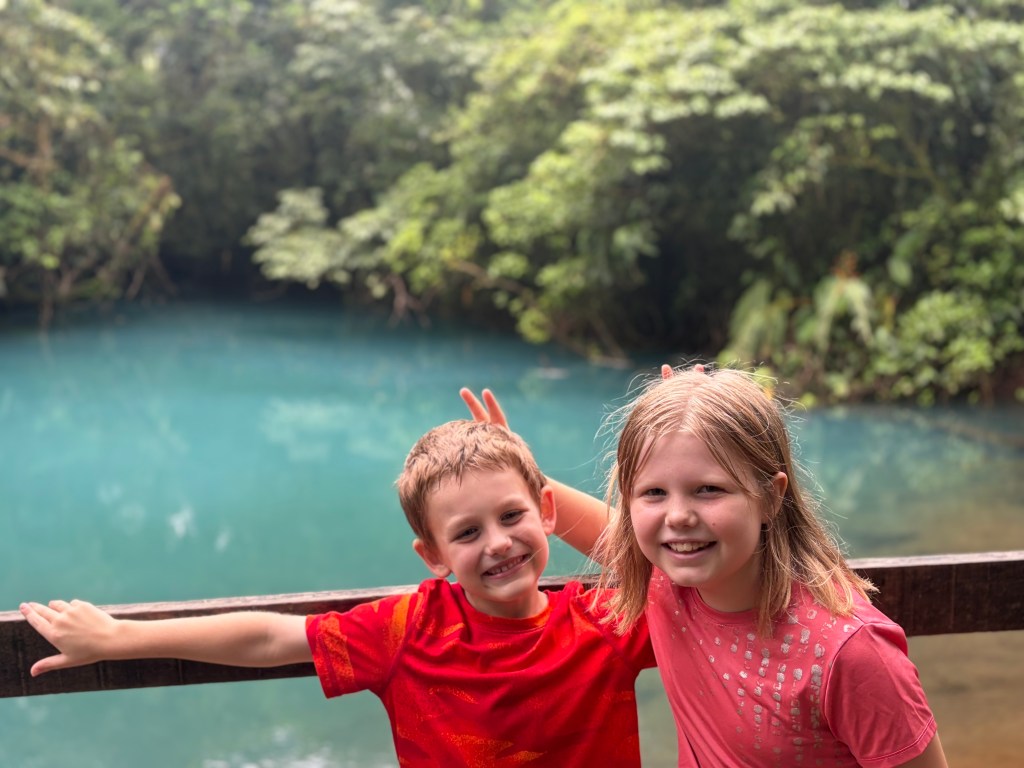
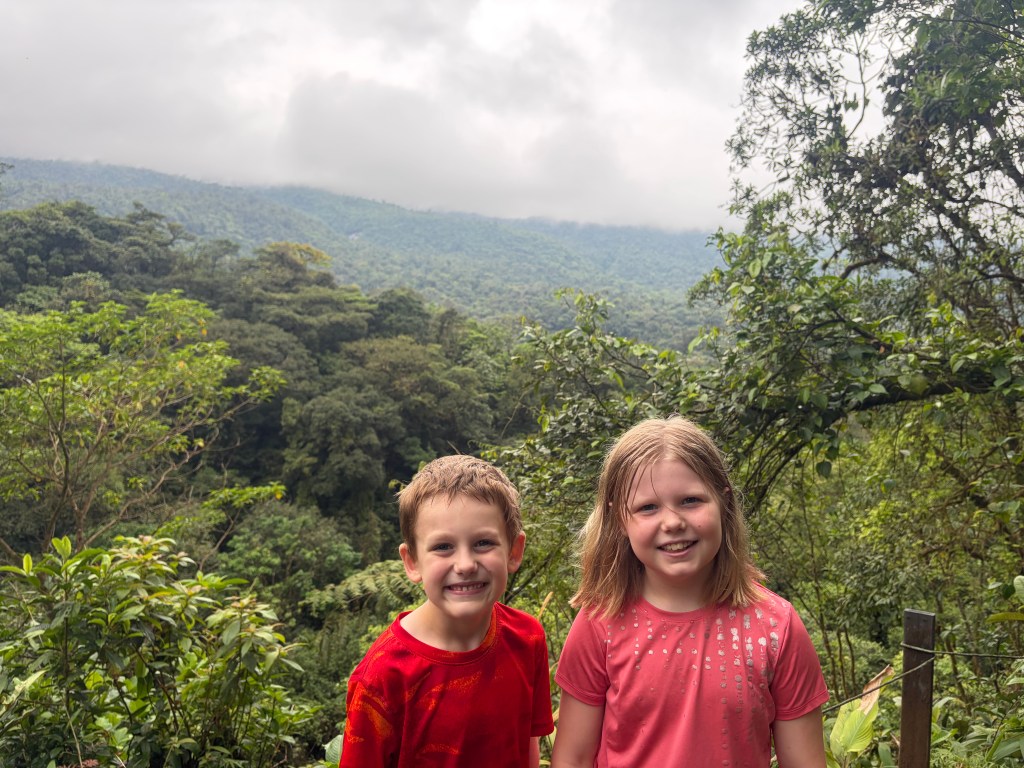
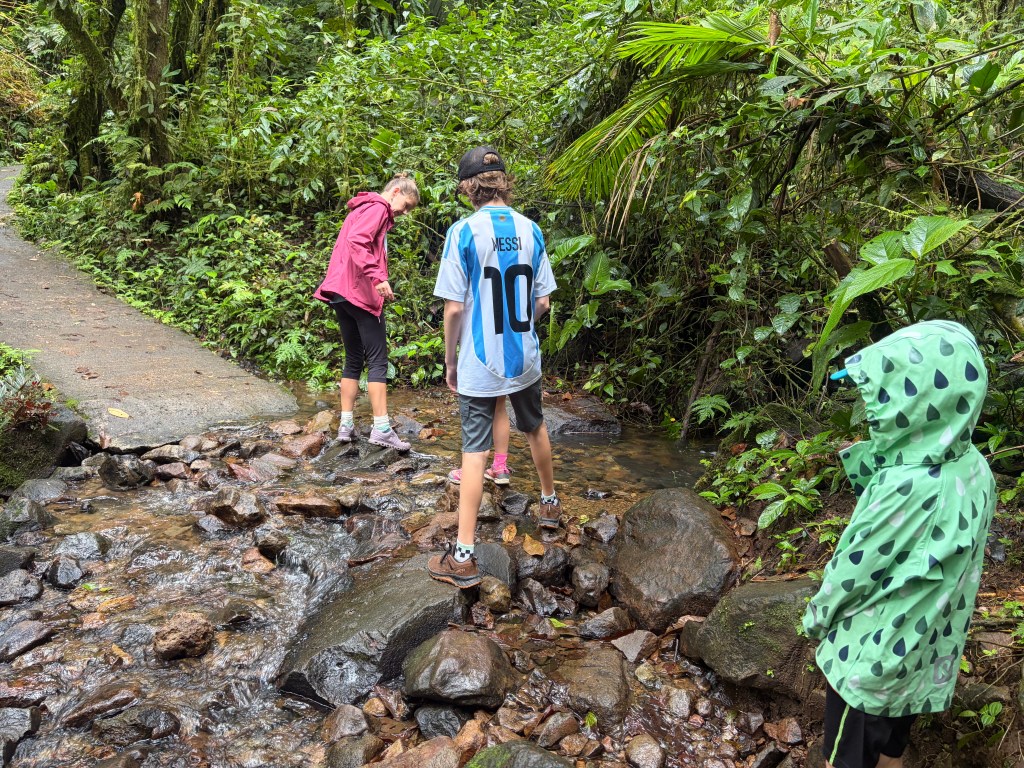
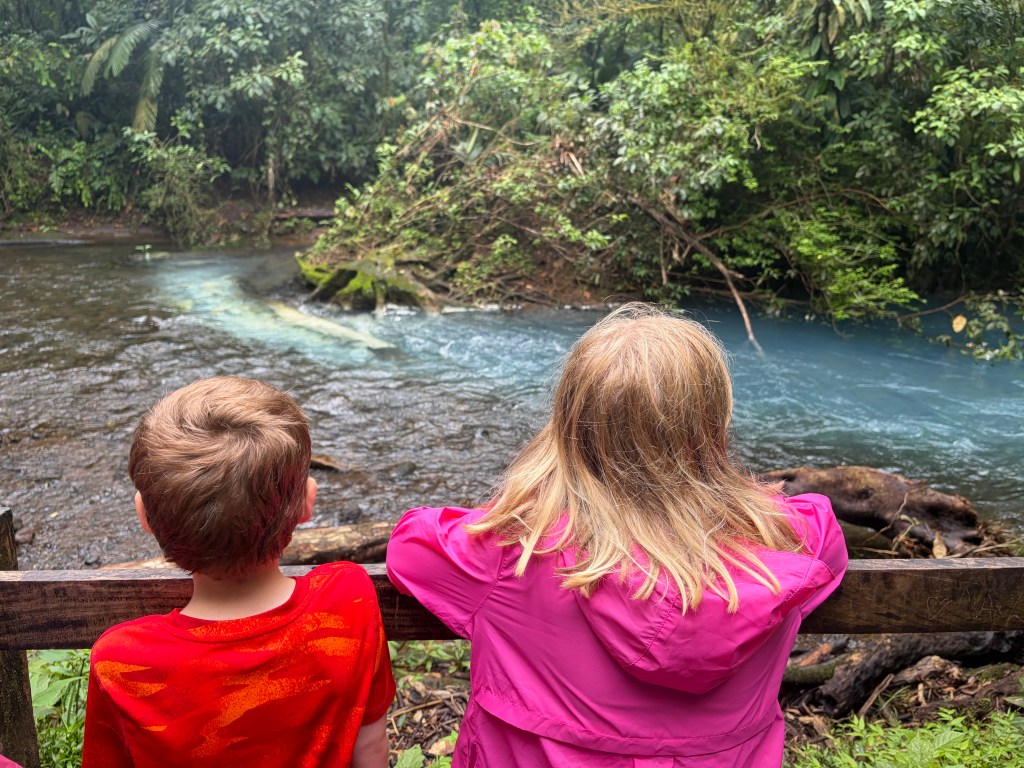
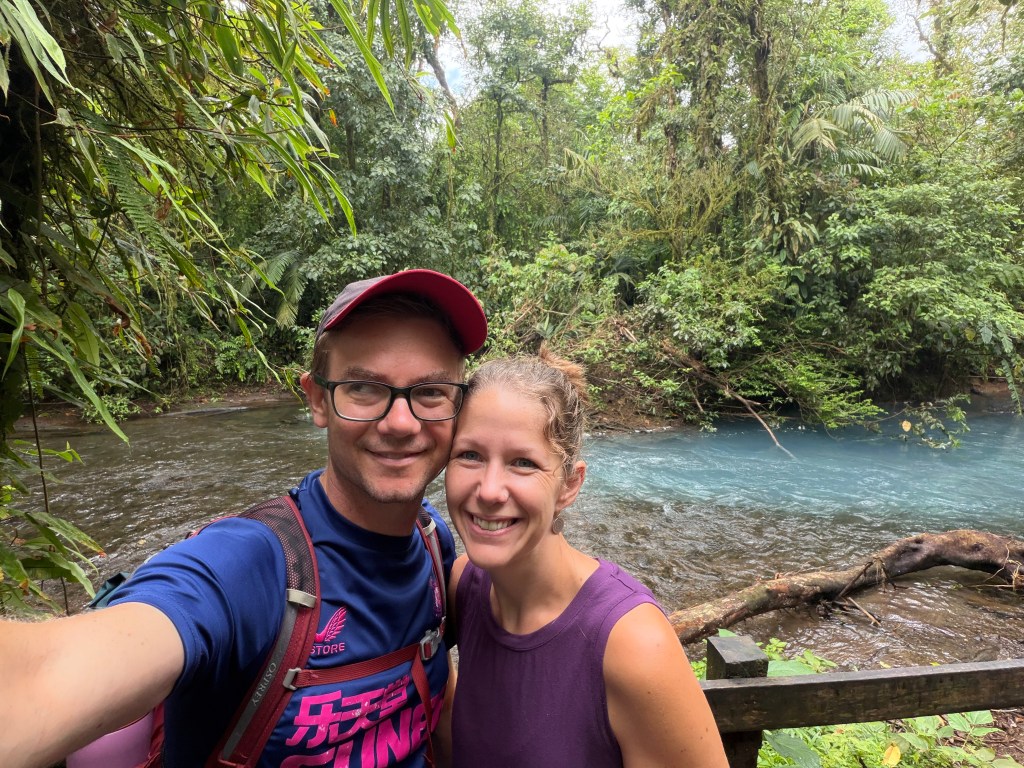
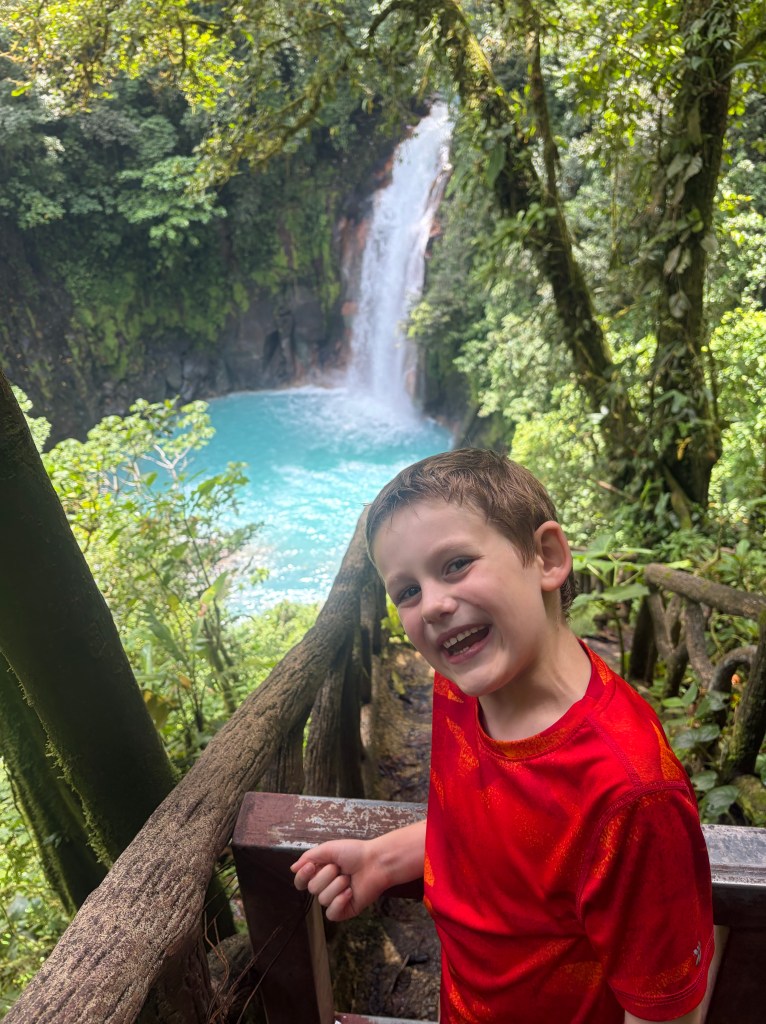
We spent a while watching the white-faced capuchin monkeys in the trees near the waterfall!
On to the Nicoya Peninsula
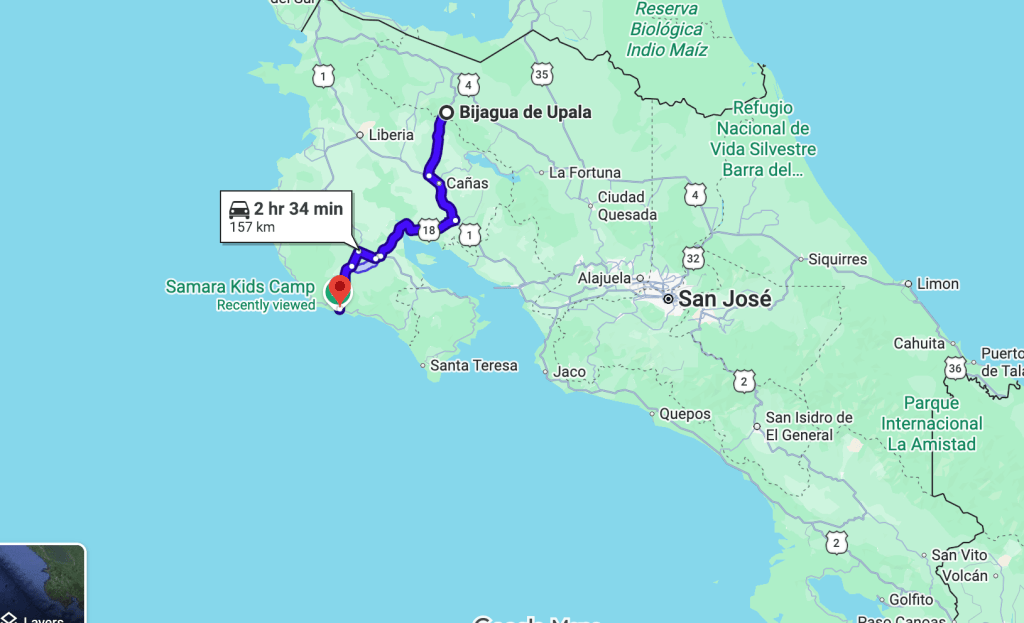
On Sunday, we said goodbye to Bijagua and headed southwest to the town of Puerto Carrillo on the Nicoya Peninsula. We’ll be spending the next two weeks in Airbnbs in the neighboring Pacific coast towns of Puerto Carrillo and Samara. Unlike Puerto Viejo, we’ll be within walking distance to beaches in both places (and have access to pools in both as well!).
How are we Worldschooling?
So, how are we worldschooling? What does school look like for us? And how do the kids feel about it?
As I mentioned in our “Why Worldschooling?” post, there are as many ways to “worldschool” as there are families worldschooling. Because families opt to worldschool for many different reasons, approaches and desired outcomes also differ.
There are essentially three main approaches:
- The bravest and most anti-institutional opt for full-on “unschooling,” where many aspects of traditional education are eschewed for a location-specific, interest-driven and child-led approach. This method seeks to harness the lived experiences and interests of the family as anchors for learning, with a heavy amount of parent involvement and a large DIY component in lesson-planning.
- Some families opt for a more formal, structured approach by enrolling their children in an online school or correspondence course. This approach looks more like traditional US homeschooling and parents play more of a supporting role, which allows for full-time work or other pursuits.
- There are also worldschooling networks and hubs in various places throughout the world that seek to resemble “normal school,” with classes, peers, and established curriculum. These hubs are often found in expat-heavy communities, with the added benefit of built-in peer interaction, physical learning spaces, and sometimes even formal or informal teachers.
There is also the question of mobility v stability. Conventional wisdom suggests stability is important in childhood, but we have also found that new experiences can keep things interesting, and we sometimes burn out quickly in some of our locations (and Airbnb homes).
We have tried to balance how long we stay in one place versus being able to see various parts of the country. I personally like the days we hit the road again, seeing new parts of the country and moving onto the next stage of the adventure. The landscape here is dramatic and beautiful, and driving through such new and diverse places can be exhilarating (if not terrifying at times).
Side note – This leads to another iteration of worldschooling that perhaps fits us best: roadschooling. For a little more detail on this angle of worldschooling, check out this well-written blog post from Routed Family.
If I had to define us, I’d say we combine formal and alternative approaches to learning, with a heavy focus on the places we are visiting, while trying to remain interest-driven and child-led to the extent possible. And I think we lean in the direction of “roadschool,” enjoying the novelty and learning that comes with exploring new places and seeing new things rather than the community-based deep cultural immersion more characteristic of many worldschool hubs.
So what Does a Typical Day Look Like?
Well, no two days look the same, and we’ve had a lot of trial and error to figure out what works best for us. Flexibility is key. For instance, we’ve learned that mornings tend to work better for learning and afternoons for outings, but we’ve also learned that the weather here is often nicer in the morning than the afternoon, so if we want to get outside, sometimes that needs to happen in the morning. Other times, things we planned aren’t going well and we need to call an audible and change course. We have the luxury to be able to do that.
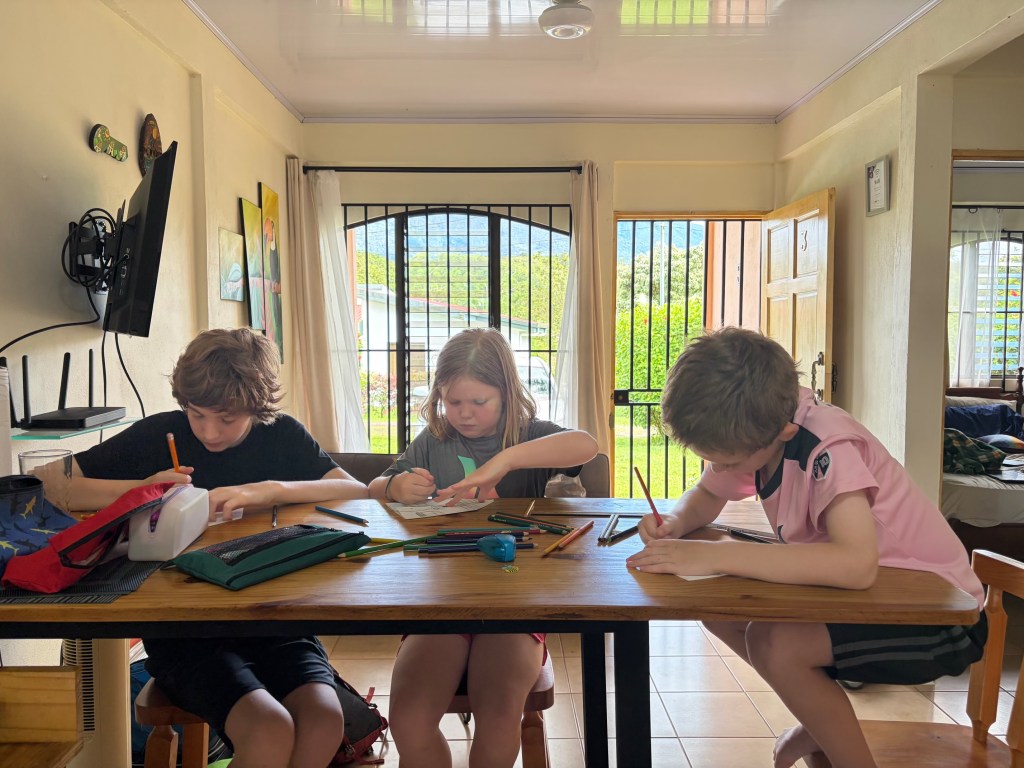
We typically start each day with some group learning, whether a social studies-themed lesson drawn from a section of the book “Indigenous Ingenuity” or science-themed reading from “World of Wonders.” Then we split up and complete individualized math, reading, grammar, and language learning with the kids. Since there are three kids and two adults, one child is often reading, practicing grammar, doing Duolingo, or on a break while the other two are receiving individualized instruction. Some days we come back together for an art project, an outing, or a group lesson in language, social studies or science.
How long does school last? It doesn’t look like a “normal” American school day, that’s for sure. Sometimes we finish school within two hours, other days we take a more leisurely approach with lots of little breaks, snacks, and diversions in between. Some days are heavy on social studies or science, and include a field trip. Other days there is a higher dose of reading. Recess and PE vary based on where we are, the weather, and what activities we have access to.
Our school is, in a word, variable.
What Curriculum are we Using?
Thinking back to the three main approaches to worldschooling outlined in the beginning, I’d say we approach curriculum with a heavy dose of #1 and a little of #2 sprinkled in. (If you need reminding, that’s mostly place-or-child-centered, individualized, interest-driven learning – Mom’s, Dad’s, or kids’ interests all come into play here). Dad’s many years spent teaching in alternative education come in quite handy here, as the approaches to worldschooling and alternative education are quite similar.
Math is math, and I’ve found it’s best done through a more structured approach. So I asked a former colleague (who happened to be the math specialist at my last school) what she recommended, and thus we landed on the Math Mammoth curriculum. We have workbooks and each kid has about 2-3 pages of one-on-one math instruction a day, with tests at the end of each chapter and online resources to supplement learning if needed. It’s pretty traditional fare (with the added benefit of individualized instruction).
For English, we mix choice with tradition. The kids are working through grade-specific Khan Academy grammar courses independently, while we give the kids an element of choice in terms of what they read. The older two have now read two books and written two book reports. It’s been a little more challenging with Younger Brother but we’ve made progress. And whether you love or hate it, AI makes creating learning activities based on whatever they’re reading or whatever we’re doing exceedingly easy. There’s also a dose of journaling that sometimes overlaps with other subjects.
Social studies and science are where things get more fun. Each of these consist of a great deal of hands-on learning supplemented by small group activities, readings, and videos. We have one of the most biodiverse regions in the world at our fingertips currently, and therefore the kids have spent a lot of time on nature walks, taking pictures, and documenting their findings in their nature journals (where they pick a plant or animal we’ve seen to research and draw). Eventually this will turn into a digital field guide to Costa Rica, and we’ll share that when it’s done.
Being a social studies nerd at heart (and teacher by certification), Dad really enjoys being able to create meaningful and interesting social studies lessons for the kids. Using the Indigenous Ingenuity book as our anchor, we’ve spent the fall learning about the technology used by the different indigenous cultures of North America, from the Olmec to the Inuit. Once we get to Europe, and have ancient and medieval historic sites readily available, we’ll shift focus to European history.
As someone who dies a little on the inside when people can’t properly identify places on a map, Dad has thrown in a heavy dose of geography as part of our social studies learning. This fall we’re focusing on the US, North America, and South America, and the kids have gotten pretty good at identifying US states and North and Central American countries. We supplement map games with mini-lessons on culture, climate, physical features, and other elements of North American geography. Then in the winter (when we’re in Australia/New Zealand) we’ll shift to Asia and Oceania, and in the spring (when visiting Spain and Portugal) we’ll finish off with Europe and Africa.
Since we also chose to live in a couple Spanish-speaking regions this year, we’ve also made Spanish lessons a part of our daily learning. Each kid spends some time daily working through Duolingo lessons (Spanish first, often followed by chess), and we often do some group vocabulary together too.
Once the formal learning is done for the day, we often cook together, read together, recreate together, work on art projects, or play other games that help support learning (Bananagrams is a favorite). Mom is great at creating art lessons tailored to the kids’ interests, and some days the kids will work on these for hours. Dad and the boys are also working their way through the Lord of the Rings trilogy in anticipation of our time in New Zealand (where we’re hoping to visit many of the filming locations, including Hobbiton).
What are the Kids’ Impressions on Worldschooling So far?
Older Brother: The best part of world school is that you can do school work on a couch or on your bed and you don’t have to spend 6 and a half hours in a boring, uncomfortable classroom. And one of the easiest things is you get to decide what you want to do and where you want to do it and when you want to do it. The worst part of world schooling is you still have to do math and all the other boring stuff and you still have to do 180 days of school.
World school is different because you don’t share a class room, you are in your home and/or place you are temporarily staying and you decide when you want breaks and lunch and other stuff. The most memorable thing so far is when I asked my dad when he would get my Percy Jackson Titans Cures book report ready and we had just finished my Percy Jackson Sea of Monsters book report.
Sister: The best part of worldschool is I get more help from mom or dad than a regular school teacher, and mom and dad are better at explaining things. I like the shorter school days, because we don’t have to sit for 7 hours. I can sit on the couch or my bed rather than at an uncomfortable desk or table. We can take breaks whenever we want to. I love one art project where we made paper houses. I have made 5 or 6 so far and plan to make at least 10. The worst part is that I don’t have friends, I miss people. I’m stuck with mom, dad, Nolan, and Oliver 24/7. It can be overwhelming not knowing what’s coming next.
Math is the same. Breaks are different, breaks are nice because we get to do stuff we didn’t get to do normally at school. I don’t like going for walks or “recess” because there are dogs and they sometimes jump up on us. One highlight was when me and my dad went zip lining and when we were on one of the platforms we saw a sloth and it was only a few feet away. The weirdest thing that’s happened so far was the scorpion in Nolan’s room.
Younger Brother: Getting to a new place is my favorite part cause it’s fun exploring new houses. I like when things go slow and easy instead of rushing around. The best thing is when we stayed at the place with the dogs. I liked going downstairs for the kitchen/ dining room. There was a stream and she had 1 very nice brown dog. The thing I like least is math, I hate all of math and writing.
World school is similar to regular school because we take walks and they remind me of a fire drill. We take walks almost everyday but we didn’t do fire drills everyday. It’s different because we don’t have to go to school and we don’t move around classes. I actually get to take ‘brain breaks,’ and at my old school we didn’t.
Got questions? We’d love to hear them!
Worldschooling is a little bit magic, a little bit mess, and occasionally a whole lot of math. If you’re curious about how we make it work, want to ask about one of our travel adventures, or have a worldschooling story of your own, send us a note!


Leave a Reply